Friday, August 14, 2015

Healthy Life Curriculum: Ola Pono Class Overview

Healthy Life Curriculum: Ola Pono
2015-2016: Kumu Becca

Aloha! I am teaching health this quarter. I feel very strongly that all of our children should be empowered to keep themselves, their families and their community healthy. Our definition of health comes from our understanding of Olelo Noeau. It includes physical health, mental health, social health and sexual health.

Our contents and standards are based on the Hawaii State standards and laws, and enriched with Kawaikini’s goals for Ola Pono, Academic achievement, Manokalanipo, and ESLRS.
The classes are divided into high school, middle school girls, and middle school boys to allow for the differences in their life stages and experiences.

I believe that all people have their own kinds of intelligence. I approach the class projects from multiple intelligences-- visual, physical, music, spatial, natural, personal, social and spiritual. My hope is that the students will leave the class with a solid understanding of their own healthy life goals with their own strengths.

Why is this class necessary for 7-12th graders? Hawaii has the 10th highest teen pregnancy rate in the nation. And kids of Hawaiian descent are far more likely to have sexually transmitted diseases and unintended pregnancies than their non-Hawaiian peers (Advocatesforyouth.org). Also Hawaii is higher than the national average for abortions (Guttmacher.org). These are the kinds of things we want to educate our kids to avoid.

Parent Participation and Opt-Out
We will be talking about sexual health. We will follow the state guidelines:      
[§321-11.1]  Medically accurate sexuality health education.  (a)  Sexuality health education programs funded by the State shall provide medically accurate and factual information that is age appropriate and includes education on abstinence, contraception, and methods of disease prevention to prevent unintended pregnancy and sexually transmitted disease, including human immunodeficiency virus.
(b)  For the purposes of this section:
"Age appropriate" means suitable to a particular age or age group based on developing cognitive, emotional, and behavioral capacity typical for that age or age group.
"Factual information" means medical, psychiatric, psychological, empirical, or statistical information that is verified or supported by research conducted by recognized medical, psychiatric, psychological, and public health professionals or organizations.
"Medically accurate" means verified or supported by research conducted in compliance with accepted scientific methods and recognized as accurate and objective by professional organizations and agencies with expertise in the relevant field, such as the federal Centers for Disease Control and Prevention, the American Public Health Association, the American Academy of Pediatrics, and the American College of Obstetricians and Gynecologists.
"Sexuality health education" means education in any medium regarding human development and sexuality, including education on pregnancy, family planning, and sexually transmitted diseases. [L Sp 2009, c 27, §2]

This means we will talk about internal and external anatomy, puberty, reproduction, and how to prevent pregnancy and sexually transmitted diseases.

My goal is transparency-- if you have any questions about what the sexual health lessons will contain, please talk to me. If you do not want your child to participate in lessons about 1. anatomy 2. reproduction 3. preventing pregnancy and disease, please write me a signed note specifying which lessons you want your child to miss.

The best option would be for parents to come to the class with your child so you can participate in the lessons, add your perspective.


Here are our weekly topics:

8/3
Mental and Emotional
8/10
Healthy Eating and Physical Activity
8/17
Personal Health and Wellness
8/24
Safety from Injury and Violence
8/31
Tobacco, Alcohol, Drug-Free Lifestyle
9/7
*Sexual Health and responsibility
9/14
*Sexual Health and responsibility
9/21
Interpersonal Communication Skills for Health
9/28
Goal setting and decision-making  and advocate for community
More information from HawaiiPublicSchools.org

​​​Sexual activity, pregnancy and STIs among Hawaii teens

Hawaii’s students, like their counterparts across the country, are at risk of experiencing unintended pregnancies and the spread of sexually transmitted infections (STIs) including HIV. The good news is that Hawaii’s students are less sexually active than their peers nationally.
However, a significant percent of Hawaii’s students are sexually active. Data from the 2011 Youth Risk Behavior Survey shows that:
  • 10.4% of middle school students and 37 % of Hawaii’s high school students report ever having had sex
  • 24% of Hawaii’s high school students reporting having had sex in the past 3 months
  • The largest jump in sexual initiation occurs between 7th and 8th grade.
  • By 9th grade, almost 1 in 4 students have had sex and by 12th grade, more than half report they have had sex
  • Among high school students, 36 percent report having experienced oral sex and 13 percent report having experienced anal sex.
The bad news is that Hawaii’s sexually active teens are less likely than their national peers to use protection. Among those who were currently sexually active:
  • Only 44 percent reported using condoms at last intercourse – the lowest percentage of any state in the nation.
  • 20 percent report they did not use any method to prevent pregnancy during their last sexual intercourse — only one state had a higher percentage.
And Hawaii’s teens are more likely to face serious consequences for their risky behaviors.

  • While both Hawaii’s teen pregnancy and birth rates have declined over the last decade, Hawaii has the nation’s 10th highest teen pregnancy rate at 93 pregnancies per 1,000 young women ages 15-19.
  • Nine percent of births statewide are to women ages 15-19
  • STIs are a major concern for Hawaii’s youth. Hawaii has the 6th worst chlamydia rate in the nation.
  • 1 in 4 sexually active adolescent females have an STI

Sunday, August 9, 2015

Script 3 Quiz

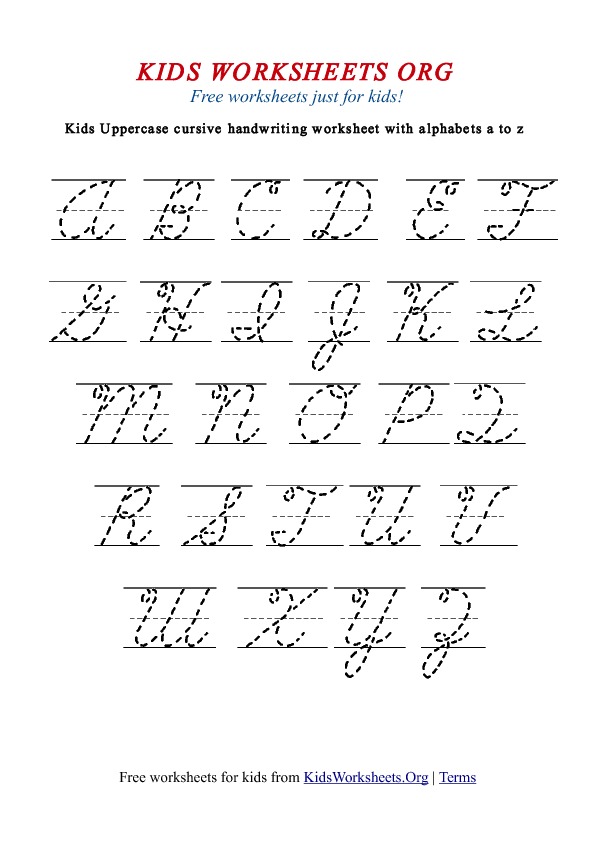
Now that you've had a chance to experiment with some interesting fonts, choose one of the poems below to rewrite in display-quality calligraphy.

Script 2 Quiz

Now that you've polished up your cursive, including those tricky capitals, give this a try. On a separate piece of paper, write all 50 states in your most beautiful cursive.


Script 1 Quiz

For your quiz, rewrite the following pangrams (otherwise known as sentences that use all 26 letters) in your most beautiful script on your own paper:
  1. While Suez sailors wax parquet decks, Afghan Jews vomit jauntily abaft.
  2. We quickly seized the black axle and just saved it from going past him.
  3. Six big juicy steaks sizzled in a pan as five workmen left the quarry.
  4. While making deep excavations we found some quaint bronze jewelry.
  5. Jaded zombies acted quaintly but kept driving their oxen forward.
  6. A mad boxer shot a quick, gloved jab to the jaw of his dizzy opponent. 
  7. The job requires extra pluck and zeal from every young wage earner. 
  8. A quart jar of oil mixed with zinc oxide makes a very bright paint. 
  9. Whenever the black fox jumped the squirrel gazed suspiciously.
  10. We promptly judged antique ivory buckles for the next prize.

Script 3

You have basically mastered cursive script. Why not branch out?

Try out some of these Calligraphy fonts.


Script 2

Cursive is cool! You are already familiar with how to write script, you may just lack practice.


Use the worksheets I give you to practice words and sentences.
Capitals are tricky! Here's a brush up:


Pay special attention to connecting the letters without changing the way they are formed.


Try writing this paragraph with tricky capitals:

Write beautifully forever!


Script 1

Cursive is cool!
Start with controlling your angle.


Make sure your shape the lines in the right order with individual letters.


Make sure you connect the letters to each other at the tops.


Write beautifully forever!


Tuesday, August 4, 2015

Eo E Lili'u Mele

The time is nearing again to get ready for Eo E Liliu!

 I will be introducing this song to the students tomorrow.

  fascinating

Here is some fascinating information about this song.

https://apps.ksbe.edu/kaiwakiloumoku/kaleinamanu/he-aloha-moku-o-keawe/he_ai_na_ka_lani

He ‘Ai na ka Lani

Author: 
 Kīhei de Silva

Haku mele: Lili‘u.
Date: 1881, 1888. Both dates appear in Lili‘u’s songbook; perhaps they indicate the initial and revised versions of her mele.
Sources: 1) Hui Hānai, The Queen’s Songbook, 118-120. 2) "He Ai no Kalani Kalakaua," Mele Book of Lili‘u, HI.M.7:117-118, Bernice Pauahi Bishop Museum Archives. 3) Ohumukini and Beamer, The Compositions by, for, and about...Queen Liliuokalani, Kamehameha Schools Extension Ed. Dept., March 1978, 20.
Discography: 1) Eddie Kamae Presents the Sons of Hawai‘i, Hawai‘i Sons, HSC 1001 (1973). 2) Dennis Kamakahi, ‘Ohana, Dancing Cat 08022-38043-2 (1999).
Text Below: Hui Hānai, The Queen’s Songbook, 119. Translation:  Hui Hānai, 119.
Ke ‘ai nei ‘o ka lani,
Hāmau ‘oukou lākou nei a‘e.
Mai noho a pane a‘e,
Ua kapu ‘ē ka ‘aha i ke ali‘i.
 Hui: ‘Ai ē, ‘ai lā.
 Ke ‘ai nei ‘o ka lani
I ka ‘oene i ke kalo mana,
Lawea mai e ka ipo laua‘e
O ka uka ‘iu‘iu o Lanihuli.
 Ke ‘ai nei ‘o ka lani
I ka poi ‘ai lehua,
Ho‘owali ‘ia e ka ipo hīnano,
Maika‘i he pahe‘e ke moni aku.
 Ke ‘ai nei ‘o ka lani
I ka ‘ōpae māhikihiki,
Ki‘ina ‘ia e Fancy Lauli‘i
O ka ua Tuahine o Mānoa.
 Ke ‘ai nei ‘o ka lani
I ka i‘a a he a‘ukū,
Hi‘i ‘ia mai e ka ipo ‘aukai,
‘Au‘au ehu kai o ka moana.
The royal one is dining now,
You should all be silent.
Make not a sound,
The assembly is kapu in the presence of the ali‘i.
Eat, enjoy! Eat, enjoy!
 The royal one is dining now
On the tender corms of the mana taro,
Brought here by the laua‘e fern sweetheart
From the high uplands of Lanihuli.
 The royal one is dining now
On the red poi made from the lehua taro,
Mixed by the hīnano sweetheart,
So fine and smooth to swallow.
 The royal one is dining now
On the māhikihiki shrimp,
Caught by Miss Fancy Dainty
From the Tuahine rains of Mānoa.
 The royal one is eating now
On that fish, the swordfish,
Brought here by the seafaring sweetheart,
He who bathes in the sea spray of the ocean.


Photo: Hawai‘i State Archives
February 3, 1889: Lili’u and King David Kalākaua at a dinner party whose guests included Robert Louis Stevenson and Stevenson’s mother.
Hui Hānai suggests that Lili‘u composed this mele for one of two events in Kalākaua’s reign: his return, in 1881, from his tour of the world, or his change of residence, in 1888, from Honolulu to Kailua, Hawai‘i. Her mele describes the special foods that were prepared on these significant occasions, the cherished friends who served them, and the respectful silence that traditionally accompanied the royal meal [1].
But "He ‘Ai na ka Lani" is more than a song about satisfying the appetite.  ‘Ai means "to rule" as well as "to eat."  The nature of the foods prepared and consumed by Kalākaua suggests that they were selected as much (or more) for their symbolism as for their taste.  "‘Oene kalo mana" in verse two refers to the last and smallest corms (‘oene) of a crop of kalo mana, a variety of taro propagated for its mana-giving, medicinal properties [2].  In one sense, the verse identifies Kalākaua as the last and "smallest" of a long line of powerful, god-like chiefs.  In another, it offers him the last remaining mana of these chiefly ancestors. 
The "poi lehua" of verse three refers, of course, to the tasty red poi made from the lehua variety of kalo, but it also suggests the figurative meanings of lehua that Kalākaua is meant to consume and embody.  A person described as lehua is "laden" with strength, speed, beauty, and skill.  He is a warrior, an expert, and a lover [3].  Poi lehua served by a hīnano sweetheart (the powder of the male hīnano blossom was thought to be a powerful aphrodisiac) further defines this installment of Kalākaua’s meal as meant to invest him with expertise that will bring fertility, ho‘oulu lāhui, to his declining people.  
The "ōpae māhikihiki" of verse four pertains, on the song’s most literal level, to "jumping" freshwater shrimp that wash downstream after heavy rains.  These are easily caught on wicker platforms, dried, salted, and served as a tasty side-dish [4].  Mahiki, however, carries more serious connotations:  it refers to the "peeling off" and disposing of wrongs in ho‘oponopono therapy and to the "exorcism of evil spirits" in ceremonies that often involved the use of shrimp called ‘ōpae mahiki [5].  As the fourth course of Kalākaua’s ritual meal, these shrimp symbolize his nation’s need for a leader capable of casting out evil and setting wrongs to right.  This symbolism would have been especially powerful in 1888 when Kalākaua’s rule had already been seriously compromised by American business interests, the Bayonet Constitution, and dissension among his own people.
The "i‘a a‘ukū" of verse five is identified by Margaret Titcomb as the swordfish whose broad bill and physical strength were more appreciated than its taste.  Hawaiians of old, she reports, did not consider the a‘ukū to be a delicacy; it was "eaten only when other fish [could] not be had; the flavor lack[ed] zest..." [6].  The contrastingly high value of the fish as a symbol of authority is suggested in Hawaiian proverbs that emphasize the consequences of disrespect and dithering; be careful not to fall short of the mark or you will be "jabbed by the swordfish":  "Mālama o kū i ke a‘u, ka i‘a nuku loa o ke kai" [7], "‘Olo‘olo aku nō i hope, kū i ke a‘u" [8].  This symbolism, particularly with regard to Kalākaua’s rule, is evident in Titcomb’s description of the a‘u as associated with rituals of conquest and power.  The fish "made whoever captured it a conqueror, gave him power to succeed over an opponent.  The fish could belong only to a chief, and was laid on the altar...with prayers by the kahuna for power for the chief" [9].  Although a‘u-at-the-altar ceremonies may not have been conducted by Kalākaua’s people, Lili‘u’s desire to endow him with swordfish-like powers is certainly embodied in the dish served him by his "seafaring sweetheart." 
"He ‘Ai na ka Lani," then, is an extraordinary composition, one that operates, simultaneously, on levels of innocent festivity and ritual solemnity.  On the first level it celebrates the pleasures of satisfying the chiefly appetite and palate:  "Hush, the chief is enjoying his favorite foods; eat, enjoy; eat, enjoy!"  And on the second level, it invests that chief with the symbolic meanings of the food he consumes:  "The kapu is invoked; eat this for mana, eat this for fertility, eat this to cast out evil, eat this to conquer and rule; eat and rule, eat and rule." 
We have no record of the performance history of this mele, but we take great pleasure in imagining its presentation, by Lili‘u herself, to "mixed" company.  Its deeper meaning would have flown completely over the heads of those who most threatened her brother’s rule, and -- at the same time -- it would have sailed straight to the na‘au of those for whom it was really intended -- her brother especially. 


Notes:
1. Hui Hānai, The Queen’s Songbook, 118-120.

  
2. Pukui and Elbert, Hawaiian Dictionary, 275, 235.

  
3. HD, 199.

  
4. Mary Kawena Pukui, ‘Ōlelo No‘eau, #176.

  
5. HD, 219.

  
6. Margaret Titcomb, Native Use of Fish, 68.

  
7. "Take heed that you are not jabbed by the swordfish, the long-nosed fish of the sea. Do not annoy that fellow or you will suffer the consequences."  ‘Ōlelo No‘eau, #2120.

  
8. "Linger behind and be jabbed by the swordfish. Better to advance with one’s companions than to stay behind and get into trouble." ‘Ōlelo No‘eau, #2501.

  
9. Titcomb, 68.

© Kihei de Silva 2006

Sunday, August 2, 2015

Sentences Quiz Level 2

Sentences Lesson Level 2

  1. Words and Sentences: What is a Sentence?
Vocab to learn for your Quiz:
  1. Subject
  2. Predicate
  3. Fragment Sentence
  4. Declarative Sentence
  5. Interrogative Sentence
  6. Imperative Sentence
  7. Exclamatory Sentence
  8. Simple  Sentence
  9. Compound Sentence
  10. Complex Sentence
  11. Conjunctions
  12. Run-on Sentences
  13. Rambling Sentences
  14. Agreement
  15. Pronoun


When you write, one of the first things that you need to master is “Sentence Fluency.” This is item #1 on our 6 Traits Rubric.

Good sentence fluency means:
  • Varied sentence lengths
  • natural sounding sentences
  • connecting words (aka subordinating conjunctions) like although, after, because, before, if, since, though, unless, until, when, whenever, where, wherever, and while
  • Active voice, not passive voice (not “the pizza was eaten by him” but “he ate the pizza”


So what is a sentence?
A sentence is a complete idea.
“The parent” not a complete idea.“The parent called” complete idea.


Subject and Predicate Required
Sentences can be short or long, but all sentences need at least one subject (usually a noun) and at least one predicate (usually a verb).


This is a complete sentence:
“Jesus wept.”   “Jesus” is the subject. “Wept” is the predicate. Even though it is short, it is a complete idea.


Fragments
If your sentence is missing a subject or a verb, it is called a fragment.
These are fragments:


“The red car.” Where’s the predicate? This is a fragment.“The store and the gas station and then to grandma’s.” Where’s the predicate? This is a fragment.“Was the last one.” Where’s the subject? This is a fragment.“Turned over on the steep bank.” Where’s the subject? This is a fragment.


Declarative
A declarative sentence states an idea. It’s not a question or a command. It ends with a period.
“It is a beautiful day.”“Kaua’i was formed by volcanic activity.”


Interrogative
An interrogative sentence asks a question. It ends with a question mark.
“How’s the weather?”“What do you think about our school T-shirts?”


Imperative
An imperative sentence gives advice or instructions or expresses a request or command. It ends with a period or an exclamation point.
“Go with a fair wind.”“Before beginning your project, please read all of the instructions.”“Shut your mouth!”


Exclamatory
An exclamatory sentence is a sentence that expresses strong feelings by making an exclamation.
“This is totally insane!”


Simple Sentences
The most basic sentences are SIMPLE SENTENCES are have one subject (noun) and one predicate (verb).
The girl sang.People are dangerous.


Compound Sentences
Compound sentence: a sentence with more than one subject or predicate.
The girl and the boy sang and danced.
People and animals are dangerous and fascinating.
Complex Sentences:
These sentences show relationships between ideas and they make your writing nice and clear.
A complex sentence has a linking word that joins two ideas. One idea can stand on its own, and the other idea is dependent and can’t stand on its own.


You make the dependent clause with conjunctions-- or linking words.


See how linking words (bolded) make these sentences into incomplete thoughts:
“The ice cream melted.” Complete idea.
Because the ice cream melted.” Incomplete idea!


“He was very rich.” Complete idea.
Although he was very rich.”  Incomplete idea!


In order to fix these sentences, you have to add the rest of the thought.
“She cried all the way home because the ice cream melted.”
Although he was very rich, he was never happy.”


Run-on Sentences and Rambling Sentences
Run-ons are simple sentences joined without punctuation or conjunctions.  Rambling sentences have too many ideas without the break of a new sentence.
“The ice cream melted it was hot it fell out of the cone onto my bare feet.” RUN-ON
“The ice cream melted because it was so hot. It fell out of the cone onto my bare feet.”  Fixed it.


“And then the ice cream melted because it was so hot because of the bright shining sun and the ice cream fell onto my bare feet and got between my toes and into my slippers and they got all sticky and that’s why mom says no more sugar for me today young lady.” RAMBLING.


“And then the ice cream melted because it was so hot because of the bright shining sun and the ice cream fell onto my bare feet and got between my toes and into my slippers and they got all sticky and that’s why mom says no more sugar for me today young lady.” Just take a breath, slow down, and tell me what happened a little at a time.


“The bright sun was shining hot. The ice cream melted and fell onto my bare feet! It got between my toes and into my slippers, and they got all sticky. That’s why mom said, “No more sugar for you today, young lady!” Ah, fixed it.


Agreement:


Sometimes in long sentences you can lose track of what you’re talking about. How many people? When did this happen? Making sure your sentences make sense in terms of tense and number is called AGREEMENT. Basic Principle: Singular subjects need singular verbs; plural subjects need plural verbs.


It’s easy to see if your sentences agree in short sentences. The subject has to match the predicate in number and tense.


Singular= is, was
plural= are, were
past= was, -ed
present = ing
future= -will


My brother is tall. CORRECTMy brother are tall. WRONG.My sisters are short.CORRECTMy sisters is short. WRONG.Yesterday they called me. CORRECTYesterday they will call me. WRONG.Tomorrow I will call them back. CORRECT.Tomorrow I called them back. WRONG.


So yes, simple sentences are easier to correct. But in compound and complex sentences it can be harder to find the subject and the predicate to make sure they match.


The rule in all the English classes is that homework is due on time.(The rule is…)A nasty virus going around all the elementary classroom is a real problem.(A virus is…)The causes of this disease are not washing hands and sharing drinks.(The causes are…)The clothes I got at the store were really expensive.(The clothes were…)The members of the halau are so proud of their hard work. (The members are…)


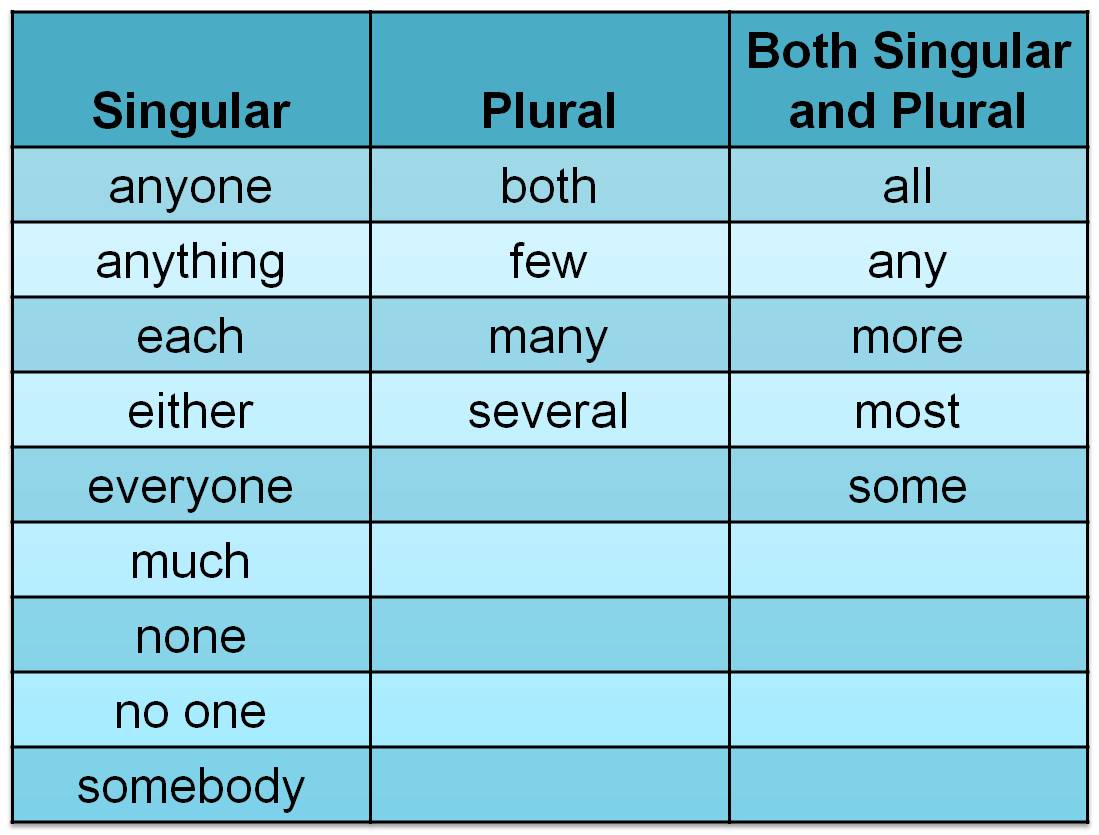
The really tricky thing with subject verb agreement is that sometimes it’s hard to tell whether or not a subject is singular or plural. This is especially true with pronouns-- or words that stand in for nouns.


indefinite table2.jpg


Anyone who saw the invitations is welcome to come. (Anyone is...) CORRECT.
Anyone who saw the invitations are welcome to come. (Anyone are…) WRONG.
Many of the books in the library are damaged. (Many are…) CORRECT.

Phew! For the quiz, be prepared to define and explain the words on the vocab list from the top.

Many of the books in the library is damaged. (Many is…) WRONG.